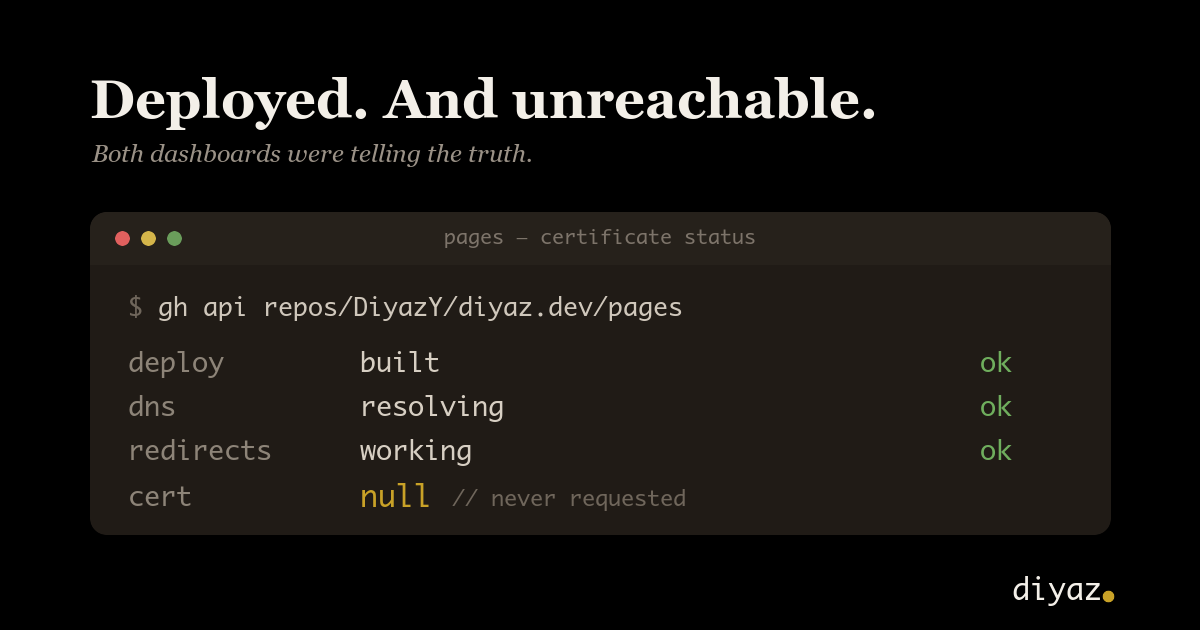
GitHub said the site was deployed. The browser said it couldn’t establish a secure connection. Both were telling the truth.
The bug wasn’t in my code. It was in when I clicked a button.
A clean migration, or so it looked
I was moving this blog from a github.io subdomain to a real domain. The kind of task you’ve done before and expect to finish before your coffee gets cold: buy the domain, point DNS at GitHub Pages, tell the repo its new name, done. GitHub even handles the certificate for you.
So I added the DNS records — four A records for the apex, four AAAA, a CNAME for www — and while they were saving, I set the custom domain on the repo. The deploy went green. The old URLs started redirecting to the new domain. Every dashboard I had said the same word: built.
Then I opened the new domain in a browser and got a connection error.
Not a 404. Not a redirect loop. A TLS failure — the browser refused to complete the handshake at all. And because the domain sits on .dev, an HSTS-preloaded TLD that browsers refuse to open over plain HTTP, there was no insecure version to fall back to. The site was, in every sense the tooling understood, live. It was also completely unreachable.
Everything was healthy
I did what you do. I checked DNS. All four A records resolved, straight from the domain’s own authoritative nameserver — no propagation excuse, no cache to blame. No conflicting CAA record telling the certificate authority to stay away. No stray DNSSEC signature. Public resolvers agreed with the authoritative ones. The redirects from the old domain worked perfectly, which meant GitHub’s edge already knew about the new name and was routing it.
When I forced a raw connection, the server handed back a certificate — the wildcard *.github.io one. Valid, just for the wrong name. So the routing layer was up. The only thing missing was a certificate that actually matched the domain.
I assumed what everyone assumes: it’s slow. Fresh domains take a while. I gave it an hour. Then a few more. Three or four hours in, staring at a site that was “deployed” and had never once loaded, I stopped believing the propagation story. Something wasn’t slow. Something wasn’t happening.
The state that wasn’t there
The thing that broke the case open wasn’t a value. It was the absence of one.
GitHub exposes the certificate’s status for a Pages site. I’d been half-reading it as I waited, expecting it to march through the stages — pending, then issued. But the field wasn’t pending. It wasn’t errored either. It was empty. Null. No state at all.
That distinction is the whole incident. pending means the request is in flight. errored means it was tried and failed. Null means it was never requested. The certificate wasn’t slow to arrive and it hadn’t failed to issue — nothing had ever asked for it. For hours I’d been waiting on a process that had never started.
Once I was looking for a thing that never started rather than a thing running late, the shape of it came clear. Setting the custom domain is what kicks off the DNS check that queues the certificate — and I’d set it while my records were still half-entered, two of the four apex addresses in and the rest a few clicks behind. The check ran against an incomplete zone, didn’t find what it needed, and quietly queued nothing.
And then, as far as I could tell, it never looked again. I gave it hours; the field stayed null. Whatever background retry exists for a certificate already in flight, nothing seemed to re-run the check that had failed to request one in the first place. It had failed in the quietest way there is — no error, just an empty field where a status should be.
The fix took ten seconds
Remove the custom domain. Add it back. That’s it.
It turns out this is GitHub’s own documented remedy — remove and re-add your custom domain to trigger the process of enabling HTTPS — which I found only after I’d already tried it out of desperation. By then all nine DNS records had been in place for hours, so this time the check saw a complete zone. The certificate state flipped from null to authorization_pending within seconds, and to approved a few minutes after. I turned on enforced HTTPS, reloaded, and the site I’d “deployed” hours earlier finally loaded for the first time.
The entire outage was the gap between when I set the domain and when I finished the DNS.
What I took from it
There’s a familiar failure story where a check runs, fails, and screams. This was the other kind — the check ran, failed, and said nothing, because from its point of view there was nothing to report. It did its one job at its one moment and moved on. The silence wasn’t a missing alert; it was the honest output of a system that had already decided there was no work to do.
Two things stuck with me.
The first is that an empty state is data. I lost hours to the difference between “this is taking a while” and “this never began,” and the only thing that told them apart was noticing that a field which should have held something held nothing. When you’re waiting on a process, confirm it actually started before you spend any time wondering why it’s slow. Absence is a reading, not a blank.
The second is about checks that fire on an action. A validation triggered by something you do — a button, a deploy, a domain you set — runs against whatever state exists at that instant, and if your inputs aren’t fully in place yet, it can fail without ever telling you. Maybe something retries later; maybe it doesn’t, or only retries the part that already got going. You don’t want to be guessing about that while the thing sits broken. Make the world fully ready before you pull the trigger — and know exactly how to pull it again when you got the order wrong.
I got the order wrong. Now I know the button that fixes it. Next time, I’ll finish the DNS before I reach for it.
Comments